Management of hazardous waste in HUS areas

Copyright: Colorbox
Employees working in areas owned by Helse-Bergen should follow hospital guidelines for waste disposal.
In the common waste disposal rooms there are cardboard boxes, inserts, red plastic bags, wires and labels. The cardboard boxes should, as a safety measure, be labelled with the appropriate label prior to use. When they are ¾ full they should be closed and placed in the waste room for collection.
Locations:
Common waste disposal room: every floor.
Hazardous waste disposal room: ask the contact person for each floor.
The contact person can be contacted if you need more information.
HUS instructions for waste
Applies to the laboratory building, the Glassblocks and KK
Instructions for HUS waste management HAZARDOUS WASTE: HUS Håndtering av farlig avfall 2022
Instructions for HUS waste management HAZARDOUS WASTE: HUS farlig avfall plakat
Instructions for Handling and labeling of waste and special waste: Håndtering av avfall og spesialavfall
Poster for sorting waste HUS Sorting guide: HUS Sorteringsveileder
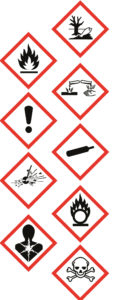 Waste management requirements:
- Disposal of chemicals and packaging without hazardous labelling, are treated as standard waste.
- Other hazardous waste must be handled and packaged in accordance with law and regulation.
- Empty chemical bottles, solvents containing cytostatics and methanol plastic containers must be declared
- The waste must be packed safely so that transport damage does not occur. Eg. Use shock absorbing material between glass bottles.
- Declaration form must be filled out for each item.
Hazardous waste:

Poster for hazardous waste. Press to enlarge.
EE waste: Wastes from electrical and electronic products contain both valuable resources and components with hazardous properties. Examples: Mercury switches, PCB-containing capacitors and circuit boards with brominated flame retardants.
Radioactive waste: Radiation sources used to treat diseases, radiation sources in instruments and analysis tools. Equipment that has been contaminated by radioactive radiation or radioactive substances.
Packaging:
1: Biological waste:
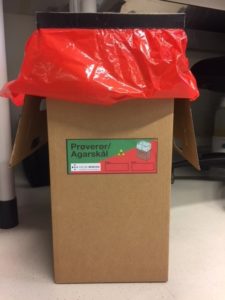 Cardboard box: For laboratory work and daily use. These boxes are sorted in 3 categories and placed in the waste rooms. Use red or yellow plastic bags according to instructions.
Cytostatic: Here smaller amounts of cytostatics, antibiotics and materials which may be cancerous, mutagens, poisonous, health damaging or damaging to the environment should be discarded. The boxes are frozen to -20°C in the Environmental hall and then transported for combustion at 900-1000°C.
Test tubes/agar plates: Contagious waste such as used agar plates and test tubes which contain blood or tissue fluids. As well disposable equipment and gloves which may be contaminated or have been in contact with organic test material, and 10 litre liquid container from cell lab (containing Virkon). The boxes are frozen to -20°C in the Environmental hall and then transported for combustion at 900-1000°C.
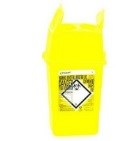
Sharps: Yellow plastic boxes with lids for hypodermic needles, scalpel blades, microscope slides and other glass/sharp objects. These yellow plastic boxes should be purchased by each group. Please note that there can not be liquid exceeding 500ml (max liquid volume for the autoclave). The boxes are then transported for combustion at 450-500°C.
2 Chemical waste:
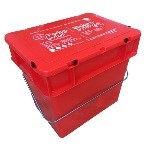 Red waste box: Dangerous waste should be packaged in its original packaging or some other suitable packaging and labelled with the declaration number.
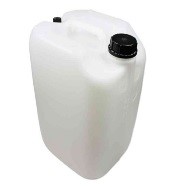 Clear plastic container: Solvent without halogen, not in its original packaging, should be put in the clear container and labelled with the declaration number.
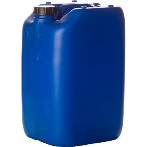 Blue plastic container: Solvent with halogen, not in its original packaging, should be put in the blue container and labelled with the declaration number.
3 Low radioactive waste:
Discarded objects, biological materials, solutions or substances that contain or have been contaminated with radioactive substances should be collected and thrown in a cardboard box containing a red bag and labelled as radioactive waste.
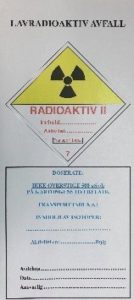
Sticker for radiation waste
Use the sticker to fill in:
- Content: i.e. Cell lines in 96-well tray
- Activity: 3 H Tritsium
- Content of isotopes: Tritsium – 3H
- Activity appr.: <0.2 μS
- Department: NN
- Date: xx.xx.xx
- Responsible: NN
Handle empty, hazardous chemical bottles:
Completion of the Declaration Form
We have received new declaration forms. The new ones come in pads, and only one sheet needs to be filled out.
- The declaration forms come in a pad.
- Use a ballpoint pen; blue or black.
- Make a copy of the declaration form after it has been filled out.
- One form must be completed for each waste material. All fields must be filled out.
- The container/chemical bottle must be labelled with the red form number located at the top right corner of the form.
- Here you will find the form for EAL code, waste material number and UN number.
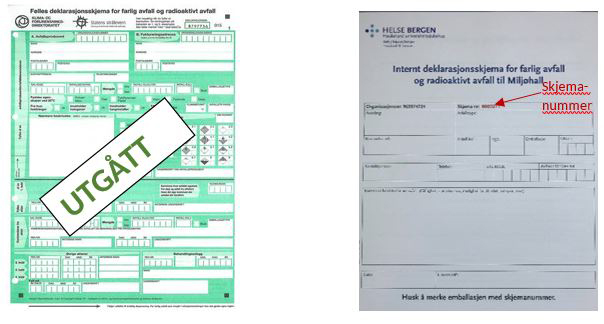
Example of how to fill in the form
The text in italics is an example of how to fill in the fields.
- Organization number: 983974724
- Department: Hemato-Oncology, Laboratory Building
- Cost center: Does not need to be filled in since the waste is sorted by Helse Bergen
- Form number: 0000277. The form number differs on each sheet
- Type of waste: Hazardous waste. Specify the type of waste, e.g. solvents without halogen, fine chemicals, acids, bases, etc.
- Number of units: 2 units. Number of items the declaration form applies to.
- Kg/L: 20 litres. For liquid waste, specify the volume in litres.
- Packaging: Containers. Specify the type of packaging.
- UN number: 1198. A four‑digit code created by the UN indicating the type of hazardous substance/goods. This code is found in the substance’s safety data sheet. Note that the UN number may also be listed as “FN‑nummer”.
Example of a completed form
Detailed description of the waste
It is important to provide the best possible description of the waste. This field should therefore always be filled out, at minimum with a description of: toxicity, possibility of mixed transport, etc., e.g. methanol, paraformaldehyde, hydrochloric acid, or any other important information.
This serves as additional safety in case of errors in EAL codes or waste material numbers. You may also include a safety data sheet for reference.
- Contact person: NN
- Phone: 12345678
- EAL code: 140603. Varies depending on classification of the waste. Both waste material number and EAL code are used to indicate waste type during storage and handling.
- Waste material number: 7152. Varies from substance to substance.
- Description of waste: Paraformaldehyde (highly diluted).
Contains halogens or not:
- With halogens: Specify which halogens and the percentage. Examples: fluorine, chlorine, bromine, iodine.
Contains heavy metals:
- Specify amount/concentration. Examples of heavy metals: antimony, arsenic, lead, cadmium, copper, chromium, mercury, nickel, selenium, tellurium, thallium and tin.
New routine from 2026, Laboratory Building:
The form must accompany the waste containers to the waste room, 1. floor, but first scan the form and upload it to Teams.
There is a dedicated folder where you can upload these “UiB Waste Declaration Forms 2026.”
Save the file with the following name: Department + the waste declaration number shown on the form.
Write the number on the waste containers. If you have multiple packages, write package 1/3, 2/3, etc. on the containers.
If there is a waste container that only has the waste declaration number written on it but is missing the form, we can identify where it comes from by checking the documentation in Teams.